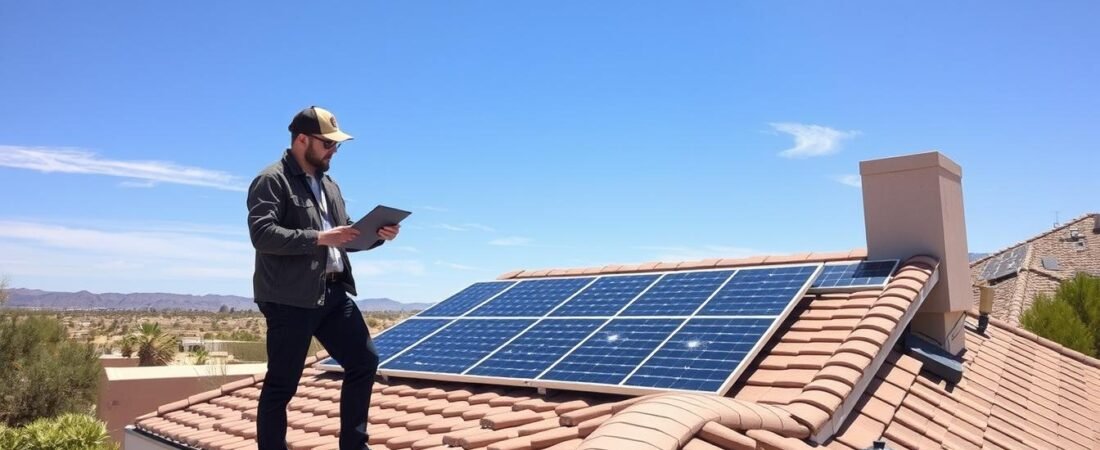
Thinking about a home energy upgrade? This short guide gives Mesa homeowners clear facts to help decide. As of April 2026, the average system runs about $2.08/W including installation, and local households can expect roughly $46,573 in electricity savings over 25 years.
Why it matters: The typical system size in Mesa is 13.77 kW, so size, installation time, and warranty all shape your investment. We cover how federal and state tax credit programs, net metering rules, and financing options affect payback and long-term value.
Use this buyer’s guide to compare systems, request a professional quote, and weigh leases versus cash purchases. Our goal is to make the path to predictable energy bills simple and practical for local homeowners.
Understanding the Solar Panel Cost Mesa Landscape
Begin with the per-watt figure — it reveals how equipment and labor add up for your home setup.
The average rate in Mesa is $2.08/W as of April 2026. That makes it easier to compare quotes from installers and manufacturers.
For a typical 13.77 kW system, expect a before-incentives range of $24,315 to $32,897. These totals reflect equipment quality, roof complexity, and crew labor.
What affects your price:
- Module efficiency and brand choices.
- Installation difficulty and permit fees.
- Options like battery backup or higher-efficiency panels.
| Metric | Typical Value | Why it Matters |
|---|---|---|
| Price per watt | $2.08/W | Standardizes comparisons across different sizes |
| System size | 13.77 kW (avg) | Determines total upfront spend and output |
| Estimated range | $24,315–$32,897 | Before federal or state incentives |
| Incentives impact | Varies | Tax and credit programs lower net price |
Looking beyond the initial price helps. Consider warranties, long-term energy production, and available tax and credit programs when choosing equipment and installers.
Why Mesa is a Prime Location for Solar Energy
Plenty of sunlight and rising utility prices make Mesa an attractive spot for home energy systems. The local climate delivers consistent sun most of the year, while higher grid rates boost the value of on-site power production.
Sunlight Availability
Mesa averages over 300 sunny days per year. That steady sunlight helps systems produce reliable output across seasons.
More sun means more generation per installed kilowatt, which improves yearly performance and strengthens the return on your investment.
Rising Electricity Rates
Arizona electricity rates have climbed nearly 20% since 2021. Higher rates make going solar a practical way to lock in lower, predictable energy bills.
Homeowners who install panels can see substantial long-term savings. Typical estimates suggest about $65,000 over a 25‑year lifespan for a well-sized system.
- Over 300 sunny days improve annual energy production.
- Rising rates increase the financial upside of on-site power.
- Combining incentives and tax credit options shortens payback and boosts net savings.
Average Pricing for Residential Solar Systems
Here’s a clear view of what homeowners pay for common system sizes and why size matters.
Typical market examples: A 5 kW system runs about $10,386, while a 10 kW system is roughly $20,772 in the local market.
Why those numbers help: The price-per-watt model makes it simple to compare quotes, equipment, and installation options. Installers will evaluate your roof and electricity use to recommend the right system size.
“Compare at least three quotes and check warranties — quality and local service matter as much as price.”
- Smaller systems lower upfront spend but produce less yearly power.
- Larger systems increase upfront investment and long-term savings.
- Financing, including loans or a lease, changes monthly payments and payback time.
| System Size | Estimated Price | Typical Outcome |
|---|---|---|
| 5 kW | $10,386 | Good for modest households; quicker payback |
| 10 kW | $20,772 | Better for high usage; higher lifetime savings |
| Price per watt | $2.08/W (avg) | Use to compare installation offers |
Next step: Request a detailed quote that lists equipment, incentives, and expected yearly production so you can compare true value and projected savings.
Factors Influencing Your Total System Investment
Understanding what drives your final invoice helps you plan a smart, long-term home energy upgrade.
System size is the first major driver. Larger systems need more hardware and crew time, which raises the overall system cost. Your installer will size the array to match your household usage and goals.
System Size Requirements
A bigger system produces more annual energy but increases upfront spending and roof work. Choosing higher-efficiency panels can lower the number of units needed and reduce the roof footprint.
Roof Complexity
Complex roofs with many angles, penetrations, or shade add labor and specialized mounting parts. That increases panel installation time and the total costs a contractor will estimate.
Equipment Efficiency
Quality inverters and durable mounting hardware boost performance and longevity. Investing in better components can raise initial price but cut maintenance and replacement risks over decades.
- Accurate site evaluations help avoid surprises on the final quote.
- Consider how panels handle heat; efficiency ratings matter in hot climates.
- Also factor in available tax and credit programs when comparing bids.
Bottom line: balance budget and performance. Spending a bit more for quality equipment and expert installation often protects your investment and improves long-term savings.
Navigating Arizona State Tax Credits
Homeowners can reduce their state tax bill by claiming a dedicated Arizona credit for eligible energy systems. The state allows a personal income tax credit equal to 25% of system expenses, up to a $1,000 lifetime maximum.
How it works: This credit applies directly against your Arizona income tax liability, so it lowers what you owe dollar-for-dollar. To claim it, file Arizona Form 310 with your return.
Eligibility rules help you qualify. The array must carry at least a two-year warranty on the panels and a one-year warranty on other equipment. Leases do not qualify; purchases and loan-financed installs do.
- Credit rate: 25% of eligible expenses (max $1,000).
- Carryforward: unused credit can be carried for five years.
- Documentation: keep invoices, warranty docs, and Form 310 copy.
| Item | Detail | Why it Matters |
|---|---|---|
| Percentage | 25% | Reduces state tax liability directly |
| Maximum | $1,000 lifetime | Caps total state savings |
| Carryforward | 5 years | Use leftover credit later |
| Qualification | 2-yr panel warranty; 1-yr other | Ensures equipment protection |
Tip: Prepare clear invoices and warranty certificates before filing. Doing so helps you capture available incentives and improve long-term savings on your electricity bills.
Federal Incentives for Battery Storage
Adding a battery brings backup power and a 30% federal tax credit that many homeowners can claim.
Overview: Homeowners who buy an eligible battery can claim a 30% federal tax credit on the full price of the unit and its installation, provided the battery has at least 3 kWh of usable capacity. This incentive is available through 2032 and is claimed on IRS Form 5695.
Battery Storage Benefits
Battery systems store excess energy from your rooftop array and release it when needed. That reduces grid reliance and delivers backup electricity during outages.
Key points to know:
- You must own the battery outright; leased systems do not qualify.
- The credit reduces your federal tax bill dollar-for-dollar.
- Many homeowners pair batteries with solar panels to boost savings and resilience.
- Choose a system that meets the 3 kWh minimum and is compatible with your existing installation and inverter.
| Item | Detail | Why it Matters |
|---|---|---|
| Federal credit rate | 30% | Significant reduction in upfront investment |
| Minimum capacity | 3 kWh | Eligibility requirement for the credit |
| How to claim | IRS Form 5695 | File with your federal return to receive the credit |
| Ownership rule | Must be owned, not leased | Leased systems are ineligible |
Understanding Sales and Property Tax Exemptions
State rules exclude eligible equipment from the 5.6% sales tax and prevent added home value from raising yearly property taxes.
Arizona’s sales tax exemption covers qualifying equipment, including panels, inverters, and batteries. That saves homeowners the full 5.6% at purchase and lowers the overall installation cost.
The property tax break is equally important. The value a system adds to your home is not assessed for property tax. In short, higher resale value won’t raise your annual tax bill.
- Exemption applies to a wide range of systems with no cap on size or value.
- Installers usually apply the sales tax exemption at point of sale to simplify the process.
- To claim the property exemption, file installation invoices and warranty documents with your county assessor.
Why it matters: These rules stack with federal incentives and the state credit to increase long-term savings and cut lifetime costs for electricity.
“Removing sales and property taxes makes clean energy more affordable for local homeowners.”
Comparing Cash Purchases Versus Solar Leases
Your financing choice shapes who benefits most from the investment and who handles upkeep.
Owning outright gives you full control. You pay upfront or use a loan, claim available tax credit, and keep long-term savings. No monthly lease payments mean higher net returns over decades.
Benefits of Owning Outright
Ownership increases lifetime savings and preserves eligibility for federal tax credit on the system.
You also control when to upgrade and can capture full resale value.
Advantages of Leasing Programs
Leases lower or remove the initial investment and provide immediate monthly savings. Programs like Palmetto’s LightReach let homeowners go green with no upfront payment.
Maintenance, monitoring, and repairs are usually handled by the provider, which makes leases attractive for hands-off homeowners.
| Feature | Cash Purchase | Lease (e.g., LightReach) |
|---|---|---|
| Upfront payment | Yes (or loan) | No |
| Monthly payments | No (unless financed) | Yes |
| Maintenance | Owner | Provider |
| Tax credit access | Owner claims credit | Provider may pass savings via lower payments |
Get a custom quote to compare projected savings, financing options, and installation timelines. That helps you decide which path meets your goals for power, savings, and convenience.
How Utility Rate Structures Impact Your Savings
How your local utility credits exported power often determines the real payback period for your home system.
In Mesa, utilities use net billing rather than classic net metering. That means export credits are set by the provider, not dollar-for-dollar retail offsets. For homeowners, this changes how quickly a solar panel installation pays back.
APS locks export credits at $0.06857/kWh for 10 years. That predictability helps forecast savings and simplifies financial models for the system.
SRP’s credits vary by season, roughly $0.02–$0.06/kWh. Seasonal rates affect summer-heavy production differently than winter output, so your annual savings will depend on timing and household usage.
- Know your utility’s true-up period and how exported energy is valued.
- Compare fixed versus seasonal credits when calculating payback.
- Factor credit levels into financing or lease decisions and long-term incentives.
“Understand your utility’s export rules first — they shape how much you save each year.”
| Provider | Export Credit | Why it Matters |
|---|---|---|
| APS | $0.06857/kWh (10 years) | Predictable annual savings |
| SRP | $0.02–$0.06/kWh (seasonal) | Variable yearly performance |
| Net billing | Provider-set credits | Different from retail net metering |
Bottom line: running the numbers with your actual electricity use and local rates shows how much energy you must produce to offset bills. With clear inputs, going solar in Arizona remains a strong path to long-term savings.
Evaluating Different Types of Solar Panels
Different module types change installation needs, lifetime reliability, and the return you’ll see from your home energy system.
Monocrystalline modules offer the highest efficiency and strong durability. They perform well where roof space is limited and often produce more output per square foot.
Polycrystalline options cost less up front and give a budget-friendly route into home generation. They need more surface area to match the same output as monocrystalline choices.
Thin-film products are lightweight and flexible. They suit odd-shaped roofs or shaded areas where standard mounting is difficult.
| Type | Typical Efficiency | Best Use |
|---|---|---|
| Monocrystalline | 18–22% | Limited roof space; long-term value |
| Polycrystalline | 15–18% | Lower upfront price; larger arrays |
| Thin-film | 10–13% | Lightweight, flexible installs |
Key point: compare efficiency, warranty, and expected lifetime output when choosing equipment. The right match reduces overall cost and improves long-term energy returns.
Also check how choices affect eligibility for a federal tax credit and local incentives before signing an installation contract.
The Importance of Professional Installation
Trusted installers optimize layout and wiring so your system delivers consistent power and fewer surprises.
Why hire a pro: professional solar panel installation ensures your array meets local building and electrical codes. Expert crews place panels to capture peak sunlight and reduce shading losses.
What a certified team handles:
- Site evaluation and optimal panel layout for maximum energy yield.
- Secure mounts and watertight roof penetrations to prevent leaks.
- All permitting, inspections, and final hookups so the job passes city review.
- A walkthrough of wiring and safety features so homeowners understand the system.
Protect your investment: the quality of the installation matters as much as equipment. A correct install preserves warranties, supports any available tax credit, and extends long-term performance.
Before you sign, verify licenses, ask for references, and compare bids. For a local pricing reference and deeper planning, see our cost guide.
Long Term Maintenance and Warranty Expectations
A clear maintenance plan keeps your investment producing reliably for decades.
What to expect: Most equipment carries a 25 to 30 years warranty that covers manufacturing defects and performance loss. Read each warranty to see what parts and rates are protected, including inverters and racking.
Warranty Coverage Details
Warranty terms differ by maker. Confirm coverage for the module, inverter, and labor. Keep invoices and serial numbers handy when filing claims.
Routine upkeep is simple. Clean surfaces a few times a year to remove dust and debris. That prevents efficiency drops and protects expected savings.
- Schedule professional inspections annually to spot wiring or mounting issues.
- Use remote monitoring tools to catch dips in output early and avoid months of lost energy.
- Follow manufacturer recommendations to keep warranties valid and extend life beyond the warranty years.
Bottom line: small, regular actions plus a clear warranty review protect your system, maintain electricity production, and preserve property value in the long run.
Conclusion
A strong plan makes the path from research to installation straightforward and rewarding.
Review your expected system cost, available tax credit, and local incentives before you sign. That helps you compare financing options and choose between a cash purchase or a lease.
Professional solar panel installation protects your warranty and boosts long-term savings. Ask for a detailed quote that shows equipment, labor, and projected electricity production.
Ready to get started? Contact trusted local installers for a custom quote and next steps. Small choices now can deliver steady power and meaningful savings for years.