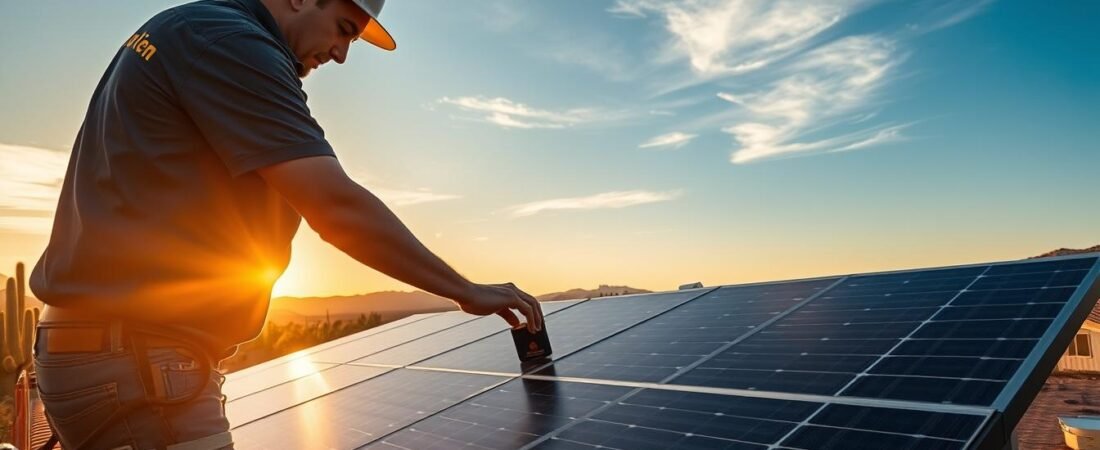
Residents in this sunny region are choosing clean energy to lower bills and boost home value. Our directory makes it simple to find top-rated local pros across the metro area.
Choose a qualified expert to ensure your home system delivers long-term performance and peak efficiency. Local contractors know the permitting rules and codes for Mesa, Arizona properties.
Requesting a free quote lets you compare prices and service packages from trusted firms. We connect you with vetted companies that guide every step, from site assessment to final commissioning.
Investing in a high-quality system reduces monthly utility costs and raises your home’s appeal to buyers. Start today to find a reliable partner and move confidently toward cleaner energy.
Why Mesa is the Ideal Location for Solar Energy
Mesa’s long, sunny seasons make it one of the best places in the country to harness clean energy. With more than 300 days of sun each year, homeowners can maximize daytime power and reduce monthly electricity costs.
The city’s push for sustainable growth supports both residential and commercial adoption. Local codes and incentives make it easier to add systems to older and newer homes alike.
Abundant Sunshine
The bright climate delivers consistent energy output across the year. That reliability helps systems reach high efficiency and gives faster returns on investment.
Sustainable Growth
Solar Topps has served the region since 2009, providing trusted service and expert guidance for installations. The firm’s experience helps households integrate new technology smoothly.
- High sun exposure boosts production most months.
- Experienced local service teams help with permits and design.
- Large property areas enable community-scale systems.
| Benefit | Impact | Typical Result |
|---|---|---|
| Abundant sunlight | Higher daily energy generation | Lower monthly electricity bills |
| Experienced local company | Smooth permitting and service | Faster, reliable installations |
| City sustainability goals | Incentives and community projects | Long-term savings and resilience |
Understanding the Solar Panel Installation Mesa AZ Process
A straightforward process helps homeowners know what to expect from the first visit through final approval.
It starts with a site review where a certified installer inspects your roof and measures household energy use. That check informs the system design and parts list.
Once design is approved, on-site work usually takes one to three days. Crews mount racking, run wiring, attach panels and set inverters with care.
- Site visit and roof evaluation to size the system.
- Permits and paperwork handled by the solar installer.
- One–three days of on-site work for hardware and wiring.
- Final town inspection for grid interconnection approval.
| Phase | What Happens | Typical Time |
|---|---|---|
| Survey | Roof review, energy assessment | 1 visit |
| Build | Racking, wiring, panels and inverters | 1–3 days |
| Sign-off | Town inspection and interconnection | Few days |
Good planning makes the process faster and improves long-term system performance. Your installer will keep you informed so the whole experience stays smooth and predictable.
Financial Benefits of Switching to Solar Power
Making the switch can protect your household budget and boost home value. Rising utility rates in Arizona—up nearly 20% from 2021 to 2024—make a clear case for generating electricity at home.
Local homeowners often see large long-term rewards. Studies show Mesa residents can save an estimated $65,000 over 25 years by choosing to power their home with a renewable system.
- Generate your own electricity and cut reliance on the grid.
- Lock in stable energy costs despite rising utility rates.
- Reduce monthly bills while adding tangible property value.
Cost analyses show a well-sized system pays back over its lifetime. Our experts help estimate your exact return on investment based on usage and roof orientation.
| Metric | Typical Result | Impact |
|---|---|---|
| 25-year savings | $65,000 (estimate) | Major household budget relief |
| Electricity rate hedge | ~20% rate increase avoided | Stable monthly cost |
| Property value | Higher resale appeal | Improved market competitiveness |
Navigating Arizona Solar Tax Credits and Incentives
Understanding available credits and sales exemptions helps you plan realistic project costs. These programs cut upfront expenses and raise long‑term savings for homeowners who add clean power systems.
Federal Battery Credits
Homeowners can claim a 30% federal tax credit for battery storage equipment that meets the minimum 3 kWh capacity. This credit is available through 2032 and applies to qualifying battery purchases tied to your home energy system.
State Tax Credits
Arizona offers a state income tax credit equal to 25% of system cost. The program has a lifetime cap of $1,000, so it helps reduce your state tax bill but has a fixed maximum benefit.
Sales Tax Exemptions
The state also exempts eligible equipment from the 5.6% sales tax. That exemption applies to panels, inverters, and battery units and provides immediate savings at purchase.
- Combine federal and state credits to lower total cost and improve ROI.
- Confirm that your installer applies sales exemptions at checkout to save time and money.
- Learn more about claiming federal and state benefits in our guide: residential tax credit guidance.
Comparing Solar Leasing Versus Outright Ownership
Deciding between leasing and buying comes down to how you want to balance monthly cash flow and long-term gains.
Leasing programs like Palmetto’s LightReach let homeowners go green with no upfront cost and predictable monthly payments. This path suits those who prefer low initial risk and no maintenance headaches.
Outright ownership gives you full control of the system. Owners can claim the federal tax credit and state incentives that lessees usually cannot. That can make ownership a stronger long-term investment.
“Owning lets you capture all future savings, but leasing can make clean energy accessible now.”
- Leasing: no large down payment, fixed monthly fee, limited incentives.
- Owning: claim tax credits and incentives, responsible for maintenance, larger lifetime savings.
- Choice depends on your budget, willingness to manage the system, and investment horizon.
- Both options reduce your carbon footprint and lower utility expenses over time.
| Feature | Leasing | Ownership |
|---|---|---|
| Upfront Cost | Low or zero | Higher (purchase or loan) |
| Access to Incentives | Limited | Full (tax credit, state incentives) |
| Maintenance | Usually handled by provider | Owner responsibility |
| Long-term Value | Moderate | High (lower lifetime utility cost) |
How Solar Panels Impact Your Home Value
Adding a home energy system can shift how buyers value your property at sale time.
Research shows real gains: Zillow data indicates homes with solar panels sell for about 4.1% more than comparable properties without them.
Local protections matter. Arizona law provides a property tax exemption for qualifying energy systems, so the higher assessed value does not raise your annual tax bill.
That combination—higher sale prices plus a tax exemption—helps homeowners capture the full value of their investment without an extra tax cost.
- 4.1% higher sale price, per Zillow.
- Property tax exemption preserves net gains for sellers.
- On-site generation reduces monthly electricity costs and boosts curb appeal.
“Investing in a high-quality system is a proven way to increase resale value and lower long-term cost.”
Exploring Solar Solutions for Mesa Religious Organizations
Religious organizations can free up funds for ministry work by investing in a tailored commercial energy system. A well‑designed system often cuts electricity and utility bills by 20–40%, creating steady savings for outreach and upkeep.
We offer specialized panel installation programs for churches and faith centers. These include customized financing options that let facilities see immediate reductions in monthly cost.
Our team performs full energy audits to match systems to unique building layouts. We also fast‑track projects to keep worship services and events uninterrupted.
We guide clients through available incentives, tax credit steps, and possible battery additions to boost reliability and energy independence.
- Customized financing to start saving right away.
- Comprehensive audits to optimize system size and placement.
- Expedited timelines to minimize disruption to services.
| Benefit | Impact | Typical Result |
|---|---|---|
| Commercial system | Lower monthly electricity cost | 20–40% utility reduction |
| Custom financing | Immediate operational savings | Funds redirected to ministry |
| Incentives & tax credit | Reduced upfront cost | Improved return on investment |
The Role of Battery Storage in Energy Independence
Modern batteries give Mesa homeowners reliable backup when the grid fails. They keep lights, refrigeration, and medical devices running until power returns.
Storing extra energy also cuts costs. You can use saved power during peak demand hours to avoid high utility rates. That reduces your electricity bills and stretches the value of what your system produces.
Many residents join the APS Storage Rewards Pilot. The program pays customers who let the utility draw on stored energy during tight grid periods. This adds a steady income stream while boosting community resilience.
- Backup power for outages and critical loads.
- Shift stored energy to high-rate hours to save money.
- Choose the right battery capacity to power your home when needed.
| Benefit | Result | Typical Outcome |
|---|---|---|
| Backup power | Lights, fridge, medical devices stay on | Peace of mind during outages |
| Peak shifting | Use stored electricity when rates spike | Lower monthly bills |
| Grid programs | Participate in APS rewards | Extra compensation and community support |
To learn more about choosing a solar battery and sizing a system for your needs, read our guide on solar battery storage systems. We help match capacity to your goals so you gain true energy independence.
Why Professional Installation Matters for Long-Term Performance
Long-term performance depends on how well the system is mounted and commissioned the first time. Proper workmanship keeps your roof secure and helps equipment resist heat, wind, and dust common in our climate.
In-house engineers and certified installer teams provide consistent quality from the roof assessment through final activation. That continuity reduces errors, speeds project timelines, and protects warranties.
- Correct mounting prevents leaks and extends system life for many years.
- Expert wiring and shading checks avoid performance losses and safety issues.
- Monitoring, troubleshooting, and maintenance services keep production high over time.
- Flexible financing options make the cost of this investment more manageable for homeowners.
Choosing a reputable company means you capture available tax credit benefits and incentives while getting reliable service. Professional crews deliver the engineering, battery integration, and post‑install support that turn an upfront expense into a lasting investment in home energy and lower utility rates.
Analyzing Electricity Rates and Utility Savings
Understanding how your utility credits exported power changes the math on long‑term savings. APS and SRP use different net billing or export credit programs. That difference affects how much value homeowners get for excess generation.
Check your local rate structure before sizing a system. Higher utility rates make self‑generation more valuable over the years. Our data shows rising electricity costs tilt the equation toward stronger lifetime savings.
We help you compare export credit rules and incentives so your system is sized for maximum benefit. A correctly sized array and the right battery choice can reduce monthly electricity bills and protect you from future rate hikes.
- Compare APS vs. SRP net billing to estimate credits for exported energy.
- Factor in local incentives and tax credit timing when calculating cost.
- Size the system to match your usage pattern for best annual savings.
“Generate more of your own electricity to lock in predictable costs and lower your exposure to rising utility rates.”
Finding Trusted Local Solar Experts
Trust and track record matter most when selecting a company to design and build your home energy system. Solar Topps has served Arizona homeowners since 2009 and offers proven experience across the Mesa area.
Use our directory to compare verified data on local firms. Each listing highlights past projects, service ratings, and neighborhood references so you can vet installers before you call.
Choosing a qualified installer ensures the full process — from system design to permits, grid interconnection, and activation — goes smoothly. Local experts know municipal rules and utility procedures that speed approvals.
- Top-rated company professionals with extensive neighborhood experience.
- Verified project history and service data for confident comparisons.
- Guidance through design, permitting, and final interconnection.
Our platform connects homeowners with reliable partners who prioritize long-term performance and customer service. Start with verified comparisons to make an informed choice and protect your investment.
Conclusion
Making the switch to home-based power delivers measurable savings and more control over monthly bills.
A well-designed system and quality panels help you capture those long-term savings while improving home value.
By using available incentives, tax credit rules, and smart sizing you can reduce the cost solar investment and start generating clean energy sooner.
Choose a trusted local expert to ensure correct panel installation and durable performance. Learn more about our team at trusted local expert.
Take the next step today to get a personalized quote and see how much solar can lower your utility bills over the years.