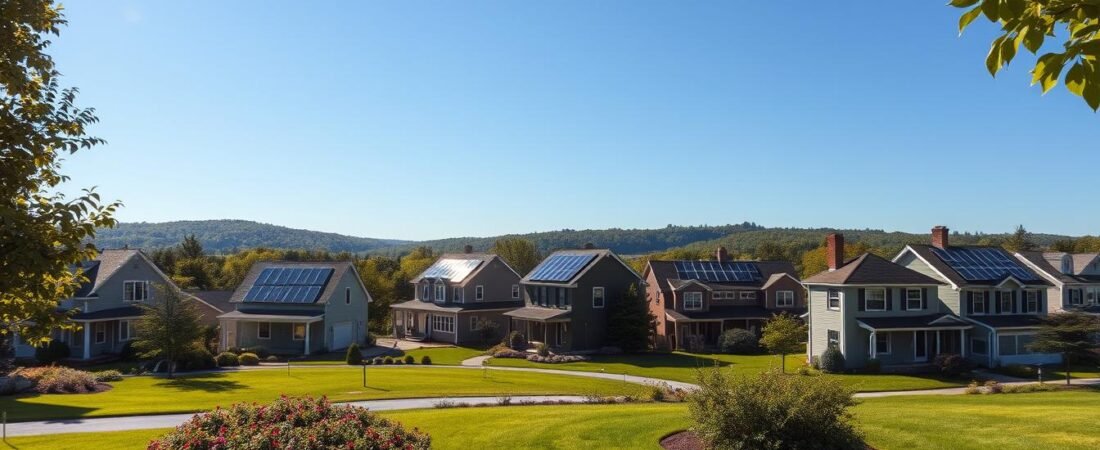
Rising utility bills are pushing many local homeowners to consider a cleaner, more predictable way to power their homes. As of April 2026, the average system runs about $2.99/W including installation, making it easier to plan long-term savings.
Investing in a rooftop system today can shield your family from fluctuating electricity prices and lower monthly bills for the next 25 to 30 years. With available incentives and the federal tax credit, the upfront expense often falls substantially.
This guide walks through what local prices mean for homeowners and how installation choices affect returns. Learn practical steps and see a clear snapshot of the typical solar panel system outlay by visiting average installation figures for Massachusetts.
Next, we’ll break down incentives, financing, and the timeline to recover your investment.
Understanding the Solar Landscape in Attleboro
How much sun your roof receives and local climate conditions determine expected yearly energy output. This helps homeowners set realistic goals for system performance.
Local factors such as roof orientation, shading from trees, and seasonal sun angle directly affect the amount of usable power your array can produce.
Modern systems perform well in this area and often supply steady energy across changing weather. Many homeowners report lower reliance on traditional electricity grids after installation.
Pro tip: A professional site assessment will measure roof pitch and sun exposure. That step helps ensure your solar panel layout matches your home’s needs.
| Factor | Impact on Output | What to Check |
|---|---|---|
| Roof orientation | High — affects peak production | Azimuth and tilt angles |
| Local climate | Medium — seasonal variability | Average sun hours per month |
| Shading & obstructions | High — can reduce yield | Tree placement & nearby buildings |
| System design | High — determines efficiency | Inverter type and panel layout |
Current Solar Panel Cost Attleboro Estimates
A clear snapshot of local pricing helps homeowners decide whether a system makes sense for their roof and budget.
Average Market Pricing
The average solar panel installation in this area is $2.99 per watt as of April 2026. That figure gives you a simple baseline to estimate total project price.
Price Ranges for Homeowners
For a typical 11.13 kW panel system, expect an average pre-incentive price of $33,268. Local market ranges run from about $28,278 to $38,258, depending on equipment and roof complexity.
Practical tip: Compare multiple quotes and confirm included warranties. Industry experts stress that roof access, permitting, and installation quality drive final differences.
- Use the $2.99/W baseline when getting estimates.
- Factor in federal and state credits to lower upfront price.
- Gather at least three quotes to find the best value for your home system.
How System Size Impacts Your Total Investment
System size directly shapes the final price and how much energy your home will produce.
A 5 kW system typically runs about $14,944 in this market. Doubling to a 10 kW array generally doubles the price, since you add roughly the same number of modules and related equipment.
Beyond the straight math, larger setups can earn modest savings on hardware through bulk pricing. Still, labor, permitting, roof work, and inverter capacity increase with scale and keep overall installation expenses rising.
- Smaller systems lower upfront outlay but may need to buy more grid power.
- Larger arrays boost on-site power and reduce utility draws over time.
- Right-sizing ensures production matches usage and avoids overspending.
| System Size | Typical Price | Primary Effect |
|---|---|---|
| 5 kW | $14,944 | Meets modest household demand |
| 10 kW | ~$29,888 | Roughly doubles production and price |
| 15 kW | Bulk pricing may lower per-watt price | Higher self-sufficiency; higher total price |
Tip: Work with an installer to model your load and find the best panel system size for long-term value.
Financial Benefits and Long-Term Savings
Generating your own power reduces dependence on the grid and creates a measurable path to long-term savings. Homeowners see large returns when they treat an array as an investment, not just an upgrade.
Calculating Your Payback Period
Average payback: Local homeowners reach break-even in about 7.11 years. After that, the system supplies mostly free energy and lowers monthly electricity bills.
- Typical lifetime savings over 25 years: $164,632.
- Reduced monthly bills protect your household from rising utility rates.
- Federal and state incentives plus the federal tax credit speed up the return on your installation.
“With a 7.11-year payback and strong 25-year savings, an on-site array often outperforms many traditional investments.”
Bottom line: The upfront expense is usually recovered in under a decade, and the remaining years offer predictable savings, improved home value, and lower exposure to future rate hikes.
Key Factors Influencing Your Installation Price
Several key variables shape what you’ll pay for a home installation and how much energy it will deliver each year.
Energy Usage Requirements
Your household electricity needs determine system size. High usage homes need more modules and related equipment, which raises the purchase and installation totals.
Right-sizing avoids overbuying and helps the investment pay back faster. A usage audit gives a clear target in kWh per year so installers can match system output to demand.
Equipment Efficiency
Higher-efficiency modules, like monocrystalline types, deliver more power per square foot. They can reduce roof area needs but may increase upfront price.
Tip: Balance efficiency with warranty terms and expected lifespan when choosing a panel system for long-term value.
Installation Quality
Quality workmanship from a reputable solar company ensures reliable performance for years. Poor installation can cut energy production and raise maintenance bills.
Get multiple quotes, check references, and confirm permits and warranty coverage before you sign.
- Several factors influence final installation price, including usage and equipment efficiency.
- Larger systems for high-energy homes have higher upfront totals despite bulk savings.
- Comparing quotes helps find the best balance of equipment, installation standards, and price.
| Factor | Impact | What to Check |
|---|---|---|
| Energy usage | Directly raises system size and price | Annual kWh and peak demand |
| Equipment efficiency | Changes area, output, and purchase price | Module efficiency and warranty |
| Installer quality | Affects performance and long-term value | References, permits, and labor warranty |
| Roof condition & size | May add labor and materials | Structural review and shading analysis |
Navigating Federal and State Solar Incentives
Understanding available tax credits and rebates is the fastest way to lower your net price and boost long-term savings for a rooftop system.
Homeowners can claim a 30% federal tax credit on qualified equipment and installation. Massachusetts adds a 15% state credit, capped at $1,000, which further trims your outlay.
Maximize incentives by sizing the system to match your household needs and by checking for local rebates tied to specific equipment or production goals.
- Stack the 30% federal credit with the 15% state credit to reduce initial costs.
- Plan your system size so you qualify for additional incentives rebates and local offers.
- Work with an experienced installer who knows how to apply for every available credit and rebate.
“Proper planning of incentives and size can dramatically improve payback and overall savings.”
Comparing Financing Options for Your Home
Many homeowners choose $0-down loans to install a system with no initial payment and start seeing energy savings right away.
If you want to keep capital free, leases and power purchase agreements (PPAs) let you get immediate monthly savings without owning the equipment or paying for installation up front.
Loans usually include interest and rates vary by lender. Still, loan holders own their system and capture long-term power savings and tax benefits.
Leases and PPAs can lower monthly bills from day one, but they change who claims incentives and who controls maintenance. Compare offers carefully to see which plan lowers your total cost over time.
| Option | Upfront | Ownership | Typical Benefit |
|---|---|---|---|
| $0-down Loan | No upfront payment | Homeowner | Owns equipment; long-term savings |
| Lease | No upfront payment | Leasing company | Immediate monthly savings; less capital tied up |
| PPA | No upfront payment | Provider | Pay for generated power only; low initial risk |
Tip: Ask installers to run side-by-side projections for loans, leases, and PPAs. A local company can map expected savings, payments, and incentive impacts for your home.
“Comparing offers is the most effective step to match financing with your budget and long-term goals.”
Selecting the Right Local Solar Installer
A trustworthy company will protect your home and help you get the best value from a new energy system.
Start by checking local reviews and business history. Look for firms like Future Energy Solar (est. 2015), OneGrid (2012), and Great Sky Solar (2012). These names show established experience in the industry and steady service over the years.
- Compare at least three quotes to weigh prices and offers.
- Read consumer reviews for workmanship and timely installation.
- Consider local, family-run companies like SunFlower LLC (2019) or All Energy Solar (2009) for personal service.
“Taking the time to verify credentials and reviews protects your investment and keeps the system running at peak performance.”
| Company | Established | Strength |
|---|---|---|
| Future Energy Solar | 2015 | Experienced installers |
| OneGrid | 2012 | Strong customer reviews |
| SunFlower LLC | 2019 | Personalized local service |
Tip: Ask each company about system size guidance, timeline, and warranty details before you commit.
Conclusion
Conclusion
Investing in rooftop panels is a long-term choice that can protect your home from rising utility bills and deliver steady savings over many years.
Carefully weigh key factors like system size, incentives, and financing before you make a purchase. Doing so helps you turn upfront spending into a solid investment.
Compare multiple offers from a trusted solar company to confirm equipment quality and professional installation. That step shortens the payback period and improves lifetime returns for homeowners.
Ready to start? Get custom quotes and explore local energy actions via this local energy actions page to learn about grants and support that may reduce your upfront needs.