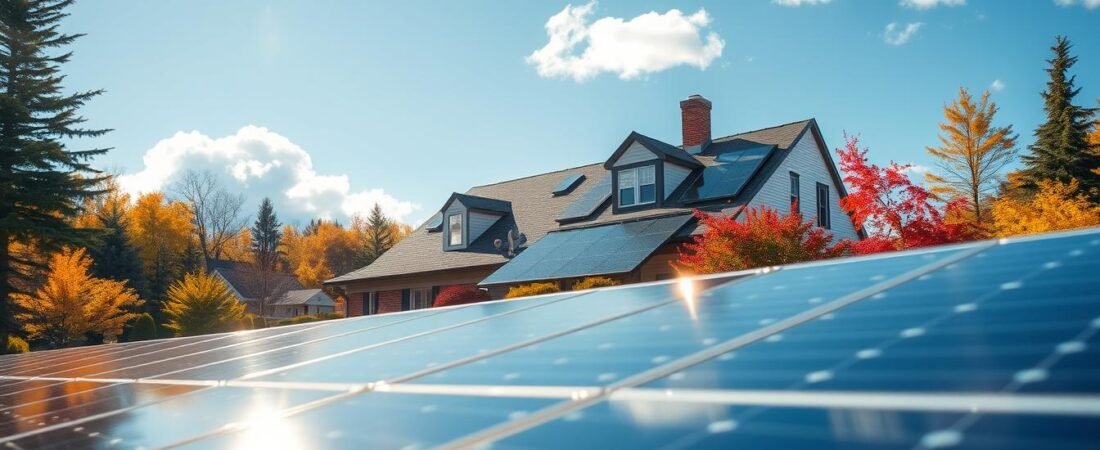
Quick snapshot: The average installed price in Maine is about $3.16 per watt as of 2026. A typical 7.2 kW system runs roughly $15,926 after the 30% federal tax credit.
Installed cost means equipment, labor, permits, and any local fees. Advertised prices often omit some of these items, so your final quote can look different.
This buyer’s guide helps you compare quotes and make a confident purchase. We’ll cover system sizing, what drives installation price, how incentives change net cost, and how to measure savings on your electricity bill.
Every home differs: roof layout, shading, and energy use change the final number. Later sections show what to ask installers and what to avoid so you can narrow the best option for your home.
Solar Panel Cost Maine in 2026: Average Price per Watt and Typical System Total
A single number—price per watt—helps cut through varying equipment packages and system sizes. In plain terms, price per watt is the installer’s quoted dollars divided by the total watts the array will produce. Use it to compare bids of different sizes or brands without getting lost in line-item details.
The 2026 benchmark in this state is $3.16 per watt. That figure is a practical starting point, but your final quote depends on roof layout, shading, and electrical work.
For a typical 7.2 kW system, the net total after the 30% federal tax credit comes to about $15,926. To estimate your own: (system size in watts) × (price per watt) = gross price, then subtract qualifying incentives and tax credits to reach net costs.
- Compare the benchmark to the U.S. average of $3.03/W to see how regional factors affect prices.
- Colder, less-sunny markets often show slightly higher per-watt prices due to installation complexity and demand.
Remember: incentives lower your net price, but they may not reduce the upfront amount you pay if you finance or use a loan. That distinction matters when you budget.
Next up: we’ll break down how system size is the biggest lever you control to hit a target electricity-bill offset.
Solar Panel System Pricing by Size: What You Can Expect to Pay
Picking the right system size means balancing your budget with the share of electricity you want to offset.
Bulk pricing explained: larger systems tend to lower the average $/W even though the total price is higher. That makes bigger installs cheaper per unit of power while increasing the upfront investment.
| Size (kW) | Net price | Avg $/W |
|---|---|---|
| 4 | $10,752 | $3.84 |
| 6 | $13,986 | $3.33 |
| 8 | $17,248 | $3.08 |
| 10 | $20,440 | $2.92 |
4–6 kW systems fit smaller homes or partial-offset goals. They have lower upfront price but cut less from your electric bill.
7–8 kW systems are common for many homes. They balance price and meaningful electricity replacement while usually fitting typical roof space.
9–10 kW systems are the highest investment but show the lowest average $/W. They suit high-usage households that want a large offset.
Sizing tip: check annual kWh on your utility bills, pick the percent offset you want, then choose the closest system size. Remember roof layout and shading can reduce how many panels you can place, and equipment choices or site complexity can still change final totals.
What Drives Solar Panel Installation Costs in Maine?
Several key factors determine what you’ll actually pay to add rooftop generation to your home. Start with how much electricity you use. Higher annual kWh needs more arrays, which raises total price even if the $/W drops with system size.
Electricity usage and system size
Usage is the starting point. More energy demand means more modules and higher upfront installation and equipment expenses.
Module types and efficiency
Monocrystalline units are the most efficient and common on houses. Polycrystalline can be cheaper but need more roof space. Thin-film is rare for residential roofs because it gives less power per square foot.
Inverter options
String inverters cost less up front. Microinverters help on complex roofs and shaded areas. Optimizers sit between those options for performance and price.
Roof, property, and electrical work
Multiple roof planes, skylights, and trees add labor and hardware. Many homes need a service upgrade; 200-amp panels are often recommended for safe interconnection.
“Quotes vary because site details and soft costs change the math — the cheapest bid isn’t always the best value.”
- Soft costs: permits, inspections, and interconnection add time and fees.
- Ask: how each quote handles upgrades, equipment, and warranties.
Where Your Money Goes: Equipment, Installer Costs, and Permitting
Understanding a quote line by line helps you spot true value and avoid surprises. A typical system splits roughly: 46% equipment, 46% installer operations, and 8% permitting/interconnection.
Equipment beyond the modules
Modules are only part of the package. Buyers pay for inverters, racking and mounting, wiring, monitoring hardware, and safety shutoffs. Panels are less than a third of total equipment expenses.
Microinverters or optimizers can add a few thousand dollars versus basic string inverters. Supply chain fees and sales tax also show up here.
How installer pricing is built
Quotes include overhead, sales and marketing, design/engineering, labor, and profit. Labor is often smaller than expected — roughly 7% of installer operations — while overhead and customer acquisition take a larger slice.
“Look past the sticker to see what the company charges for service, warranty handling, and follow-up.”
Permitting and interconnection
These fees cover permits, inspections, and utility interconnection. They vary by town and utility rule; reputable installers usually manage the paperwork to save you time and headaches.
- Value lens: higher-quality equipment and longer warranties raise upfront spending but can pay off in decades of better production.
- For a regional benchmark and to compare pricing, see this Maine price per watt study.
Solar Incentives and Tax Credits Available to Maine Homeowners
Incentives can shrink your net purchase price, but they arrive in different forms and at different times.
The federal investment tax credit (ITC): 30% and how to claim it
The federal tax credit equals 30% of your installed system. Homeowners who buy the system outright or with a loan can claim it on their federal return the year after installation.
It’s a nonrefundable credit against income tax. That means you need enough federal tax liability to use it in the first filing year. If you can’t use the full amount, some taxpayers may carry excess credit to a later year—check IRS guidance or your tax advisor.
No state tax credit in Maine — clearing the confusion
Despite common wording you might hear, the state does not offer a separate state tax credit for rooftop generation. Expect the federal ITC to be the primary federal incentive that reduces net cost.
Stacking local rebates and paperwork tips
Local rebates or utility credits occasionally appear. When available, they can be stacked with the federal tax credit to lower the final net price and improve payback.
- Keep contracts, invoices, and proof of payment to support your tax claim.
- Owning the system (cash or loan) usually lets homeowners claim incentives directly.
- Leases and PPAs often pass incentives to the lessor, not the homeowner.
“Incentives help, but the biggest savings come from good design, fair pricing, and strong on-roof production.”
Net Metering in Maine: How “Net Energy Billing” Impacts Your Electric Bill
Maine’s net energy billing decides how exported power converts into dollar value on your utility statement. When your system makes more electricity than the house uses, the surplus is sent to the grid and becomes credits on your account.
How credits work in practice: exported energy produces bill credits that offset later charges. Credits smooth seasonal swings when production and use don’t line up.
Utilities covered and what that means
State rules apply to major utilities, including Versant, Central Maine Power, and Eastern Maine Electric Coop. Smaller providers follow the same net metering framework, so customers statewide get consistent treatment.
Why Maine’s buyback policy stands out
Maine’s version of net billing is widely seen as consumer-friendly. Where other states reduce credit values, this program gives fair crediting that preserves savings and shortens payback time.
“Good net metering boosts lifetime returns by ensuring exports get reasonable credit against your future bill.”
Buyer takeaway: when you compare quotes, ask installers to model savings using current net energy billing assumptions and to put those assumptions in writing. Policy details can change, so confirm the latest program rules at quote time.
Is Solar Worth It in Maine? Payback Period, Savings, and Real-World Returns
A clear way to judge value is to convert a quote into a simple payback timeline and a 25‑year savings estimate.
Real quote example: a 7.7 kW system estimated to produce 9,719 kWh per year had a gross price of $24,332 and a net price of $17,032 after the 30% federal tax credit.
Payback snapshot: under a cash purchase this example returns the initial net investment in about 8.8 years. That payback period assumes full retail net metering and steady electricity prices.
Lifetime value: the same setup avoids roughly $65,297 in utility bills over 25 years, showing why the investment can pay off even in cooler climates.
“Ask each installer for a year‑one savings estimate and a 25‑year cashflow table so you can compare apples to apples.”
- Most impact on payback: system price, local electricity prices, available incentives, and net energy billing rules.
- Financing or changing usage patterns alters the payback timeline and total savings.
- Production varies with roof orientation, shading, and weather — get site-specific data.
How to Estimate Your Home’s Solar Cost and Compare Quotes in Maine
Start by gathering a year of utility bills and a quick roof sketch to make quotes comparable. This keeps each estimate apples-to-apples and speeds accurate sizing.
What you’ll need
Checklist: pull 12 months of electricity bills, note annual kWh, and flag major changes like adding an EV or heat pump.
Walk the roof and note orientation, shading, number of roof planes, skylights, and any tree trimming the property might need.
How to compare quotes
Focus on these metrics: price per watt, projected annual production (kWh), specific equipment models, and warranty terms (product, workmanship, production).
| Metric | What to ask | Why it matters |
|---|---|---|
| Price per watt | Clear $/W and total price | Allows direct comparison across system sizes |
| Projected production | Year‑one kWh and modeling assumptions | Drives real electricity savings |
| Equipment & warranties | Brands, model numbers, and term lengths | Impacts lifetime performance and service |
Red flags and installer selection
Beware of offers that are far below market or that leave equipment vague. Vague specs, missing warranties, or unrealistic production numbers are common warning signs.
Why local, established companies win: long-lived systems need service over 25–30 years. A local company is likelier to answer the phone for warranty work and monitoring help.
“Get at least three quotes, ask for cash and financed scenarios, and don’t pick solely on the lowest upfront number.”
Actionable takeaway: request 3+ quotes that use the same offset target and itemize adders like electrical upgrades. Compare price, equipment, and real production before you sign.
Conclusion
Use these final notes to turn headline numbers into a practical next step for your home.
Keep the benchmarks in mind: the statewide average is about $3.16 per watt, and a typical 7.2 kW system lands near $15,926 after the 30% federal tax credit.
Choose system size first. That decision drives total price, expected savings, and how many modules fit on your roof. The right price pairs clear production numbers, trusted equipment, and an installer who will support your array long-term.
Incentives and federal tax credits cut net outlay and improve payback. There’s no state tax credit, so count on the federal credit and local net energy billing to shape lifetime returns.
Next step: gather 12 months of bills, confirm roof basics, and request multiple quotes that list $/W, warranties, and modeled production. If two proposals are close, pick the one with the stronger warranty, clearer assumptions, and a proven local track record for better long‑run savings and peace of mind.